Project scope
Venue, audience geometry, target use, schedule and destination market establish the acoustic and documentation boundary. Include scaled drawings when they are available; rough dimensions are suitable only for an initial conversation.

PROJECT INTAKE
A precise first message includes venue type, audience dimensions, mounting boundaries, program duty cycle, project country and the decisions already made.
For touring work, note truck-pack limits, approved pick points and the time available for prediction and soundcheck. For fixed installation, add reflected ceiling plans, amplifier-room ventilation, cable routes, environmental exposure and the authority that will review the project. These facts are more useful than a request for the loudest or largest available box.
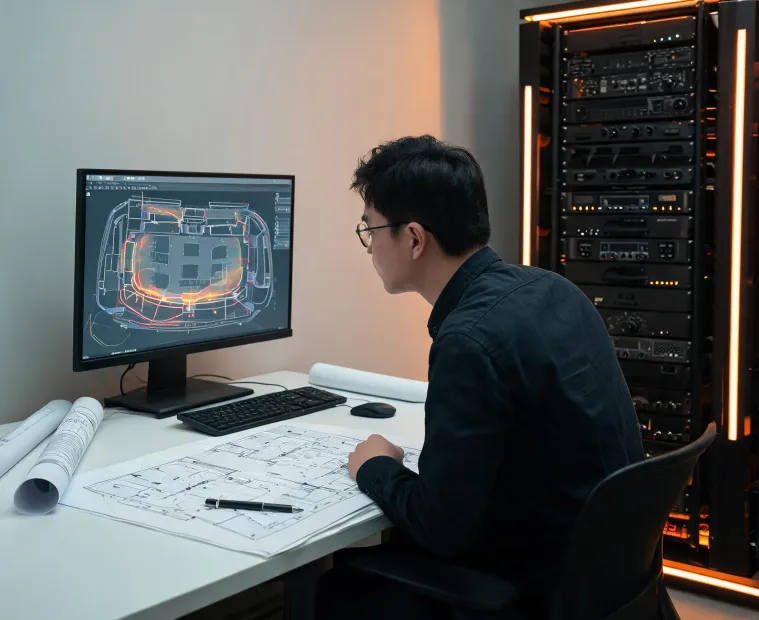
Venue, audience geometry, target use, schedule and destination market establish the acoustic and documentation boundary. Include scaled drawings when they are available; rough dimensions are suitable only for an initial conversation.
Candidate categories, source count, routing, power, rigging and environmental limits reveal which decisions depend on an exact model. Add the expected program level and duty cycle instead of relying on a standalone wattage target.
Identify whether the need is system review, documentation, dealer coordination or commissioning. A service fault also benefits from the model, serial record, firmware, signal path, protection state and a concise reproduction sequence.
SEND THE BRIEF
Do not send passwords, confidential access credentials or personal data unrelated to the project.
The first response can organize missing evidence, but it cannot provide structural approval, certify a life-safety design or prove acoustic performance without the required project information. Those boundaries keep the inquiry useful and prevent a preliminary discussion from being mistaken for a final design release.
When reporting an existing-system issue, describe what changed, which channels are affected, whether protection indicators appear, and the steps that reproduce the fault. Preserve the current preset and wiring record before making broad changes; simultaneous edits make the cause harder to isolate.