JBL founded
James B. Lansing established the company around loudspeaker and transducer engineering.

A HISTORY OF LOUDSPEAKER ENGINEERING
From the 1946 founding associated with James B. Lansing to today's touring, cinema and installed-sound work, the useful thread is disciplined translation: transducer behavior, enclosure design, directivity and system integration.
FORWARD BRIEF
The roadmap is not a promise of a single future model. It is a design direction: clearer data context, more coherent workflows between acoustic prediction and commissioning, and service records that survive personnel changes.
SELECTED MILESTONES
James B. Lansing established the company around loudspeaker and transducer engineering.
JBL became part of Harman, connecting loudspeaker development with a broader professional audio portfolio.
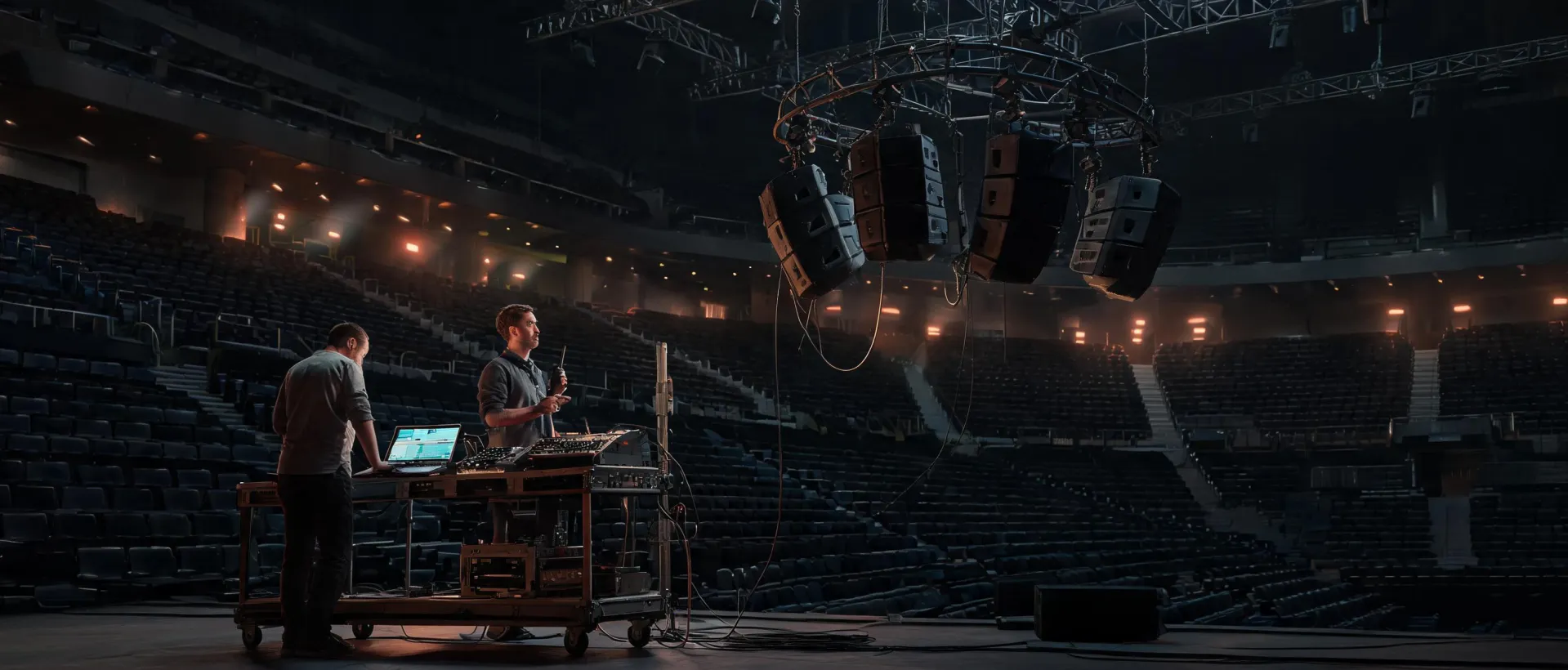
Large-format arrays made aiming, rigging, amplification and processing inseparable design inputs.
Modern projects add routing, firmware, monitoring and documentation to the acoustic commissioning record.
PROJECT PARTNERS
Venue owners, consultants, integrators, structural engineers, production teams and trained operators each own a different risk. Good delivery makes those boundaries explicit.
The acoustic consultant defines audience targets and validates prediction assumptions. The structural engineer approves loads and attachments. The integrator owns installation, labeling and test records, while venue operations maintains access, ventilation and repeatable startup. Treating these roles as interchangeable leaves gaps that a product specification cannot close.
At handover, retain the exact model list, aiming file, amplifier allocation, processor preset, firmware record, polarity and delay checks, representative measurements and unresolved exceptions. This evidence is intentionally more modest than an invented performance claim, but it is usable by the next engineer.
Ask for model-specific documents, prediction assumptions, final settings and measurement conditions in one project record.